Filters, filter media, water pumps, and air pumps all play a crucial role in maintaining water quality in aquariums. Filter media can generally be divided into three main types: mechanical, chemical, and biological. In practice, many mechanical and chemical filter media also support bacterial growth.
The purpose of biological filter media is to provide surfaces for beneficial bacteria to attach and grow. In a fish tank, if bacteria have limited space, they cannot handle the load of densely stocked fish. Using filter media to expand their living space enhances the tank’s natural purification ability.
Today, we’ll explore the top filter media—some of which are cost-effective or even free to use—and explain the main types of water filtration materials.

Top 10 Filter Media
1、Polyurethane Sponge
- Commonly used in wastewater treatment, this is the same as the bio-sponge in aquariums.
- Large pores and high surface area disrupt water flow, making it an excellent filter choice.
- Easy to clean and budget-friendly. Before use, soak for 24 hours, air-dry for 2 days to remove plastic odors, and ideally disinfect with potassium permanganate.
2、Glass Rings (Air Rings)
- Made by high-temperature quenching, these porous rings are highly breathable.
- Unlike ceramic rings, which mimic the shape but have no internal pores, glass rings have open ends that allow air flow.
- Drawback: they gradually break down over a year. Reuse requires boiling for an hour to remove trapped organic matter.
3、Ceramic Rings
- Although lacking internal pores, the textured surface allows beneficial bacteria to attach.
- Slower to degrade than glass rings and can be reused after rinsing in tank water.
- While not as effective as glass rings, they outperform smooth-surfaced materials.
4、Acrylic Fiber (Polyester Fiber)
- Fine, interwoven fibers create a dense yet water-permeable structure.
- Removes visible particles and is often used together with activated carbon.
5、Coal Slag
- A byproduct of boiler burning with a honeycomb structure.
- Non-soluble and effective at odor absorption.
- After washing, it’s a cost-effective filter material.
6、Ion Exchange Resin
- Available as cationic or anionic resins.
- Removes chlorine, calcium, magnesium, and metal ions, effectively reducing water hardness.
7、Activated Carbon
- Black, rice-grain-like particles with a highly porous surface.
- Widely used in ornamental aquariums for its strong adsorption capacity.
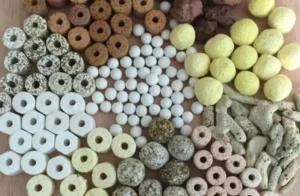
8、Bacteria Rings
- A variation of bacteria houses, some even have pores similar to glass rings.
- Textured surfaces disrupt water flow and maximize water contact, cultivating beneficial bacteria more effectively than glass rings. Highly recommended.
9、Bio Cotton (Biochemical Cotton)
- Dense cotton available in black or blue.
- Functions both as mechanical and biological filter media, capable of cultivating nitrifying bacteria.
10、Bacteria Houses
- Larger, block-shaped versions of bacteria rings.
- Slightly less effective due to limited surface contact with water flow.
- Best used in bottom-filter tanks placed vertically to maximize water contact.
Common Types of Aquarium Filter Materials
1. Filter Cotton
- The most basic filter media.
- Performs mechanical filtration by trapping uneaten food and fish waste.
- Clean regularly; replace when worn out.
2. Bio Cotton
- Denser than regular filter cotton, usually black or dark blue.
- Supports both mechanical and basic biological filtration by cultivating beneficial bacteria.
3. Ceramic Rings / Bio Rings
- Porous ceramic cups or rings designed for biological filtration.
- Provide surfaces for nitrifying bacteria to grow, which helps break down harmful ammonia, nitrites, and nitrates.
4. Bacteria Houses
- Larger, block-shaped versions of ceramic rings.
- Function almost identically, offering extensive surface area for biological filtration and beneficial bacterial growth.
Conclusion
Choosing the right filter media depends on the tank size, fish load, and filtration needs. A combination of mechanical, chemical, and biological media usually yields the cleanest and healthiest aquarium environment.