Goldfish,as traditional ornamental fish,are beloved by enthusiasts for their graceful posture and rich colors.However,goldfish are known as”waste producers”due to their vigorous metabolism,which places high demands on water quality maintenance.The filtration system,as the core of the aquarium ecosystem,directly determines water quality stability and goldfish health.This article will delve into the working principles,filtration effects,and applicable scenarios of three mainstream filtration systems—bottom filtration,top filtration,and hang-on-back filtration—to help breeders make the most suitable choice.
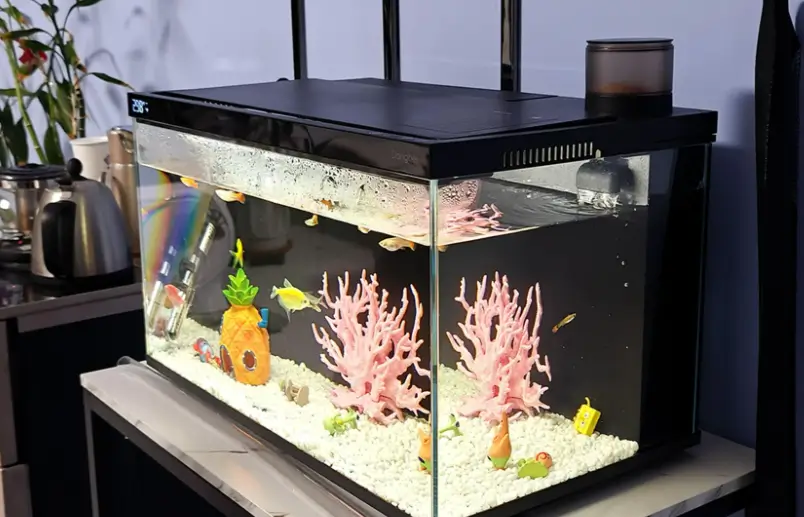
Bottom Filtration System:Professional Choice for Large Tanks
Bottom filtration systems are currently recognized as highly efficient filtration solutions,particularly suitable for medium to large aquariums and high-density breeding environments.Their core design utilizes the space in the cabinet below the aquarium to house an independent filtration chamber,achieving water circulation between the main tank and the bottom filter through an overflow system.
Working Principle
A bottom filtration system typically consists of several key components:
Overflow Area:Located on one side of the main tank,water automatically flows into the bottom filter when the water level exceeds the overflow plate
Physical Filtration Area:Contains filter cotton and other materials to trap fish waste and food residues
Biological Filtration Area:Holds ceramic rings,bacterial houses,and other filter media to cultivate nitrifying bacteria
Water Pump Area:Houses the water pump,which returns filtered water to the main tank
The water flow follows a closed loop:”Main Tank→Overflow Area→Physical Filtration→Biological Filtration→Water Pump→Main Tank,”forming an efficient water circulation system.
Advantages
Superior Filtration Capacity
The large volume of the bottom filter allows for ample filter media,supporting multi-stage filtration(physical,biological,chemical)and ensuring high water quality stability.A well-designed bottom filtration system can have filter media volume exceeding 20%of the total water volume,providing abundant habitat for nitrifying bacteria.
Concealed and Aesthetic
All filtration equipment and pipelines are hidden within the cabinet,keeping the main tank clean and visually appealing.This is a significant advantage for breeders who value home aesthetics.
Convenient Maintenance
Filter media can be removed and cleaned without disassembling the tank,and water changes can be performed in the bottom filter,minimizing disturbance to the main tank ecosystem.Some high-end bottom filtration systems also feature automatic water replenishment,further reducing maintenance difficulty.
Strong Expandability
The bottom filter can easily accommodate additional equipment such as heaters,UV lights,and protein skimmers to meet different breeding requirements.
Disadvantages and Considerations
Complex Installation:Requires precise design of the overflow system to prevent leaks or pump burnout.Beginners are advised to choose pre-made bottom filter tanks rather than DIY.
High Cost:The complete system,including the bottom tank,water pump,and piping,typically costs over a thousand yuan,with large systems potentially reaching tens of thousands.
Noise Issues:High-power pumps may produce low-frequency noise,requiring silent equipment or sound insulation measures.
Water Level Monitoring:Must closely monitor water level changes,as water circulation will be interrupted and the pump may burn out if the water level drops below the overflow area.
Applicable Scenarios
Bottom filtration systems are particularly suitable for:
Medium to large aquariums over 80cm
Goldfish varieties with high water quality requirements,such as Ranchu and Thai Lion
High-density breeding environments
Home display where overall aquarium aesthetics are important
Top Filtration System:Economical Entry-Level Choice
Top filtration systems are the most common type,mounted on top of the aquarium.A water pump draws water from the tank to the top filter tray,achieving both physical and biological filtration.
Working Principle
Top filtration systems have a relatively simple structure:
Submersible Pump:Placed inside the main tank to draw water
Filter Tray:Located on top of the aquarium,divided into physical and biological filtration zones
Outlet Pipe:Returns filtered water to the main tank,usually designed as a waterfall
The water flow path is:”Main Tank→Submersible Pump→Physical Filtration→Biological Filtration→Waterfall Return→Main Tank.”
Advantages
Economical
Top filtration systems are affordable,with basic models costing only a few dozen yuan,making them suitable for beginners on a budget.
Easy Installation
No drilling or complex modifications required;simply place on top of the aquarium,making it suitable for upgrading ready-made tanks.
Convenient Maintenance
Filter media replacement is simple,with no need to disassemble complex components.Daily cleaning only requires removing and rinsing the filter cotton.
Good Oxygenation
The waterfall return increases contact between water and air,significantly improving oxygen levels in the water.
Disadvantages and Considerations
Limited Biological Filtration:Small filter tray volume and insufficient filter media capacity result in low efficiency of nitrifying bacteria cultivation,making it difficult to handle high-density breeding.
Poor Aesthetics:Exposed filter trays occupy space above the aquarium,potentially blocking lights and affecting overall visibility.
Severe CO₂Escape:Turbulent water flow causes significant loss of carbon dioxide in planted tanks,making it unsuitable for aquatic plant scaping.
Noise Issues:Water flow noise can be significant,especially in quiet environments.
Improvement Solutions
To address the limitations of top filtration systems,breeders often adopt the following improvements
Adding Drip Trays:Expanding filter media capacity and enhancing biological filtration by stacking multiple filter trays
Installing Reverse Air Lift:Improving nitrifying bacteria activity by using water flow to drive air circulation
Optimizing Outlet Design:Reducing water flow noise by using silent outlet nozzles or rain pipes
Applicable Scenarios
Top filtration systems are suitable for:
Small aquariums under 60cm
Low-density breeding environments
Budget-conscious beginners
Bare tanks(non-planted tanks)
Hang-on-Back Filtration:Compact Space Solution
Hang-on-back(HOB)filters,also known as waterfall filters,are external filtration devices fixed to the aquarium wall with clips or suction cups.They are compact and easy to install.
Working Principle
HOB filters have a compact structure:
Water Inlet:Located at the bottom of the device,drawing water from the tank
Filter Chamber:Contains filter cotton and biological filter media
Water Outlet:Located at the top of the device,returning water in a waterfall pattern
The water flow path is:”Main Tank→Water Inlet→Filter Chamber→Waterfall Outlet→Main Tank.”
Advantages
Compact Size
Does not occupy internal tank space,suitable for small aquariums or as auxiliary filtration.
Easy Installation
Plug-and-play design with no complex piping,suitable for beginners or temporary use.
Low Cost
Basic models cost only a few dozen yuan,making them economical.
Good Oxygenation
The waterfall outlet increases contact between water and air,improving oxygen levels.
Disadvantages and Considerations
Limited Filtration Capacity:Small filter media capacity limits its use to low-density breeding or small aquariums.
Noise Issues:Water flow noise can be significant,especially in quiet environments.
CO₂Escape:Open design causes gas loss,making it unsuitable for planted tanks.
Water Level Restrictions:Specific water level requirements;the device may not function properly if the water level is too low.
Applicable Scenarios
Hang-on-back filters are suitable for:
Micro aquariums under 40cm
Breeding or quarantine tanks
As auxiliary filtration equipment
Low-density breeding of small goldfish
Core Parameter Comparison of Three Filtration Systems
| Parameter | Bottom Filtration | Top Filtration | Hang-on-Back |
| Filtration Capacity | ★★★★★ | ★★★☆☆ | ★★☆☆☆ |
| Suitable Tank Size | 80cm+ | 40-80cm | Under 40cm |
| Stocking Density | High | Medium-Low | Low |
| Aesthetics | ★★★★★ | ★★☆☆☆ | ★★★☆☆ |
| Noise Level | ★★★☆☆ | ★★☆☆☆ | ★★☆☆☆ |
| Maintenance Difficulty | ★★★☆☆ | ★★☆☆☆ | ★★☆☆☆ |
Selection Guide:Three Steps to Find the Best Solution
Choose by Tank Size
Small tanks(<60cm):Hang-on-back or basic top filtration
Medium tanks(60-100cm):Top filtration with drip tray combination
Large tanks(>100cm):Bottom filtration system
Choose by Stocking Density
Low density or small fish:Hang-on-back or basic top filtration
Medium density or medium fish:Top filtration with drip tray combination
High density or large fish:Bottom filtration system
Choose by Maintenance Effort
Ample time and DIY enthusiast:Top filtration with drip tray combination
Seek convenience and efficiency:Bottom filtration system is the best choice
Temporary use or auxiliary filtration:Hang-on-back filtration
Special Considerations for Goldfish Keeping
As high-waste fish,goldfish have special requirements for filtration systems:
Priority to Physical Filtration:Goldfish produce large amounts of waste,so physical filtration must effectively trap solid waste.
Enhanced Biological Filtration:Sufficient filter media is needed to cultivate nitrifying bacteria to process large amounts of ammonia.
Water Flow Control:Goldfish have special body shapes and are sensitive to strong water flow,requiring appropriate adjustment of outlet design.
Based on the above characteristics,recommended filtration solutions for goldfish:
Small tanks(<60cm):Top filtration with drip tray combination
Medium to large tanks(>60cm):Bottom filtration system
Pure hang-on-back filtration is not recommended for goldfish unless used as auxiliary filtration
Filtration System Optimization and Maintenance Tips
Filter Media Configuration Principles
Physical Filter Media:Placed at the front of the water flow to first trap large particles
First layer:Coarse filter cotton(traps large particles)
Second layer:Fine filter cotton(traps small particles)
Biological Filter Media:Placed after physical filter media to provide habitat for nitrifying bacteria
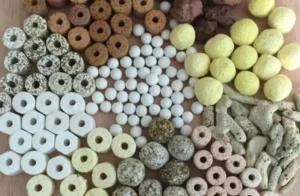
Common media:Ceramic rings,bacterial houses,bio-balls,etc.
Media quantity:Recommended to reach 10-20%of total water volume
Chemical Filter Media:Used as needed,such as activated carbon(absorbs odors),algae-removing stones,etc.
Note:Chemical media should be replaced regularly to prevent release of harmful substances after saturation
Maintenance Schedule and Methods
Daily Maintenance:
Monitor water level changes and replenish water promptly
Clean debris from water inlets to prevent blockages
Test water parameters weekly(ammonia,nitrite,nitrate)
Regular Maintenance:
Physical filter media:Rinse weekly with tank water
Biological filter media:Check monthly and gently rinse with tank water if necessary
Media replacement:Replace physical media every 3-6 months,biological media every 1-2 years
Precautions:
Never use tap water to clean filter media to avoid killing nitrifying bacteria
Do not replace all filter media at once;replace in batches
Minimize disturbance to the aquarium ecosystem during maintenance
Common Problem Solutions
Cloudy Water
Check if physical filter media is clogged or needs replacement
Increase biological filter media quantity to strengthen the nitrification system
Reduce feeding amount to control organic input
Excessive Filtration System Noise
Check if the water pump is loose;add shock-absorbing material if necessary
Optimize pipe connections to reduce water flow impact
Adjust outlet design and use silencing devices
Decreased Filtration Efficiency
Check if filter media is clogged or aged
Verify if the water pump flow rate matches the tank size
Check for water flow short-circuiting
Conclusion
The filtration system is the lifeline for the healthy growth of goldfish.Choosing the right filtration solution is a crucial step in successfully keeping goldfish.Bottom filtration systems are the preferred choice for medium to large aquariums due to their superior filtration capacity,top filtration systems are suitable for beginners with their economical advantages,and hang-on-back filters are ideal for small tanks or as auxiliary filtration.
Regardless of the system chosen,it is essential to consider personal circumstances and breeding needs while emphasizing daily maintenance and scientific management.Through the analysis in this article,readers should now have a comprehensive understanding of the three mainstream filtration systems and be able to make the best choice based on their actual situation,creating a clear and healthy living environment for their goldfish.